
Choosing a Ridge Expansion Technique That Avoids Grafting
Posted by Kelcee on Sep 24th 2026
A narrow ridge can quickly change a routine treatment plan into an advanced case. When a CBCT reveals a ridge width of 4 mm, treatment planning often becomes more complex, bringing grafting, longer timelines, additional surgery, and case acceptance challenges into consideration.
Ridge expansion offers a solution for implant placement in a narrow ridge, though not every expansion method behaves the same way in bone. The right choice depends on what the ridge can safely do.
A Staged Augmentation May Cost More Than You Think
Staged augmentation is predictable in trained hands. It also carries costs that never appear on the invoice.
Horizontal augmentation usually adds four to six months before implant placement. That means a second surgery and a second recovery for your patient. Many patients hesitate the moment they hear the word graft. Some accept treatment anyway. Others defer, and deferred cases have a way of never coming back.
There is chair time to weigh as well. Flap release, membrane fixation, and tension-free closure all take real minutes. Donor site morbidity adds another variable in autogenous cases. None of this makes augmentation wrong, but it raises a fair question: “Can this ridge be expanded with the patient’s autogenous bone instead?”
Reading the Ridge Before You Choose a Technique
Expansion is a bone composition decision first. Width alone will not tell you enough.
Osseodensification will not create tissue that does not already exist, but it can optimize and preserve the bone that is present. Published ridge expansion protocol guidance sets clear thresholds before plastic expansion is attempted.
Carefully evaluate these indications on the CBCT:
- Total ridge width at the crest and a few millimeters apical
- A trabecular core of at least 2 mm
- A trabecular to cortical ratio of at least 1:1
- Ridge shape, since a narrow crest with a wider base expands more predictably
- Residual height and proximity to adjacent anatomy
A ridge of roughly 4 mm represents the practical floor for predictable expansion. Below that, an intra-bony ridge split or a staged approach may serve the patient better. Thick cortical plates paired with a thin trabecular core also raise fracture risk.
Comparing Expansion Options Side by Side
Several methods claim to widen a ridge. They differ in control, in patient experience, and in what happens to the bone itself.
- Osteotomes and mallets. Effective in select sites, though percussion creates an uncomfortable experience for patients. Mallets have been associated with benign paroxysmal positional vertigo in the implant literature.
- Screw expanders. These widen the site mechanically. Thread engagement can fracture a thin buccal plate.
- Ridge splitting with vertical releasing cuts. Useful in specific anatomy, and highly technique sensitive when the base is narrow.
- Excavating drills. These remove bone from a site that has none to spare.
- The osteotomy widens through controlled plastic deformation rather than excavation.
The evidence is worth reviewing directly. A 2024 comparative clinical study in the Journal of Baghdad College of Dentistry evaluated 40 osteotomies in ridges of 3 to 5 mm. Mean ridge width in the Osseodensification group rose from 4.20 mm to 5.48 mm. Width gain was comparable to screw expansion, while operating time favored Osseodensification.
Earlier preclinical split-mouth work reported higher insertion torque values with Osseodensification than with conventional osteotome expansion. You can review that body of peer-reviewed research before applying it clinically.
How Osseodensification Changes the Expansion Conversation
The technique relies on a non-excavating bur design. Run in reverse (densifying mode) with copious irrigation, the Densah® Bur flutes compact bone laterally instead of cutting it away. Autogenous particles stay in the site rather than leaving on the drill.
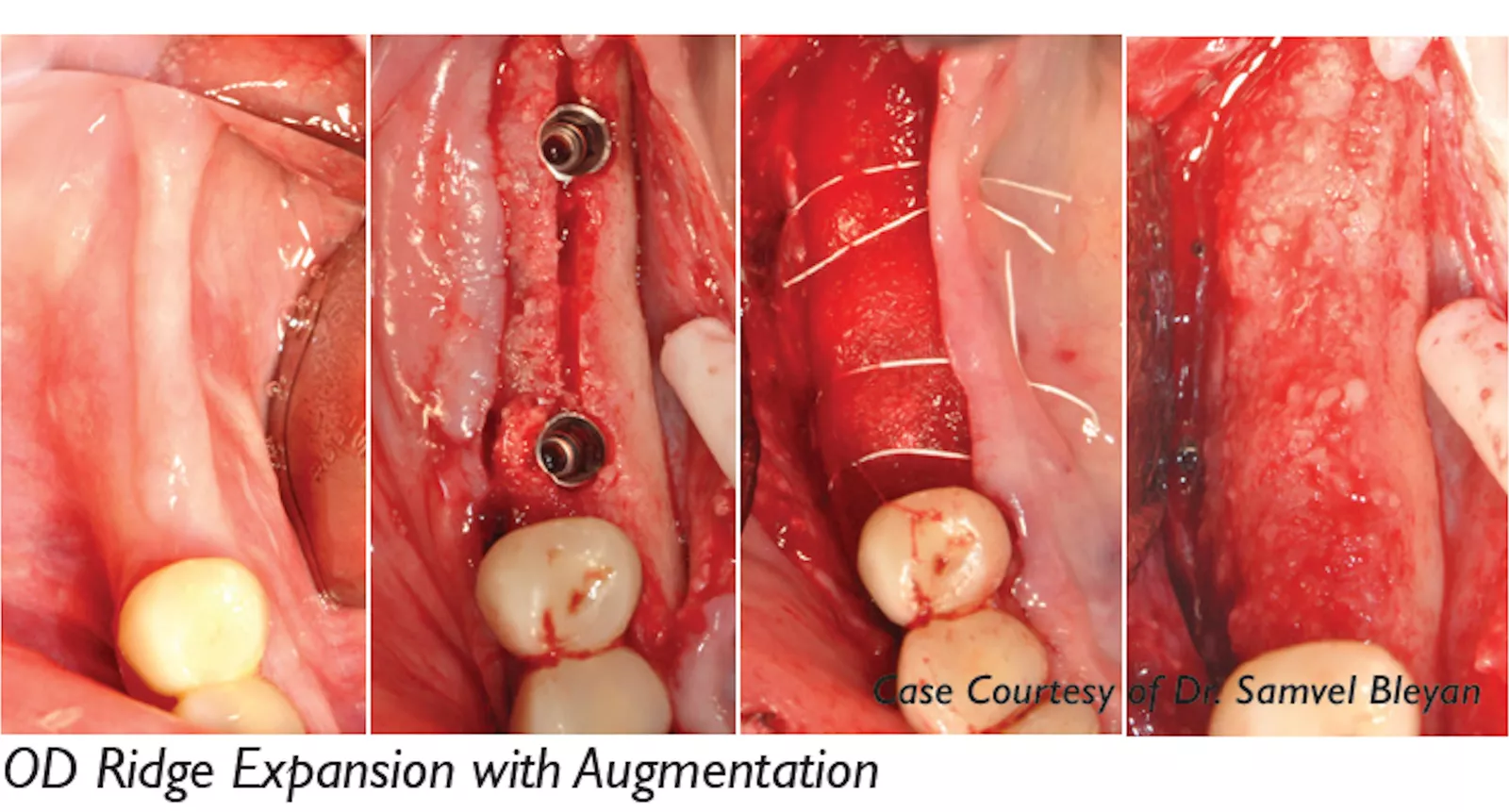
Sequencing matters as much as speed when creating a densified site. Use Densah® Burs in small increments at 1000 rpm. Oversize the osteotomy to at least the implant major diameter. Prepare 1 mm deeper than implant length, particularly in the mandible.
Even a well-expanded ridge may still benefit from a hard and soft tissue veneer contour graft around the implant to promote secondary stability. That is a thin contour procedure, not staged augmentation. The goal is to avoid a separate surgery and a multi-month delay. For initial ridge widths under 3 mm, the two-stage guided expansion graft approach remains the more appropriate path.
Versah® engineered the Densah® Bur to make this densification technique reproducible across implant systems and both jaws. Clinicians who want hands-on practice and one-on-one guidance before their first case can train on actual bone specimens and simulation models through the Osseodensification Academy.
Your Next Narrow Ridge Case Can Be Simpler
You already know which cases sit in your treatment planning queue the longest. The 4 mm anterior maxillary ridge is usually one of them. You do not have to default to a staged graft every time one shows up on the scan.
With the right diagnostic thresholds and the right sequence, that same ridge may be ready for an implant in a single visit. Look at your next three narrow ridge cases and ask whether expansion is on the table. If you want to minimize your learning curve and discover how you can implement Versah’s Ridge Expansion Protocol into your workflow, register online for a hands-on course with us or call +1 844-711-5585.