
Bone Densification Replaces Bone Removal at the Osteotomy Stage
Posted by Kelcee on Sep 10th 2026
Osseodensification is changing how implant sites are prepared, one osteotomy at a time. For decades, standard drilling removed bone to make room for an implant. That approach works, but undersizing weakens the tissue clinicians rely on for long-term stability. Osseodensification takes a different path. Instead of excavating bone, it compacts and preserves bone, autografting the site from within.
This shift matters because primary stability and the pressure put on bone at the time of implant placement drive overall implant survival rates. Densah Burs allow clinicians to take compromised bone and convert it to denser walls, resulting in better primary stability. Additionally, clinicians who once saved Densah Burs for complicated cases in compromised bone quality are now using Densah Burs in nearly every procedure.
What Happens During Osseodensification
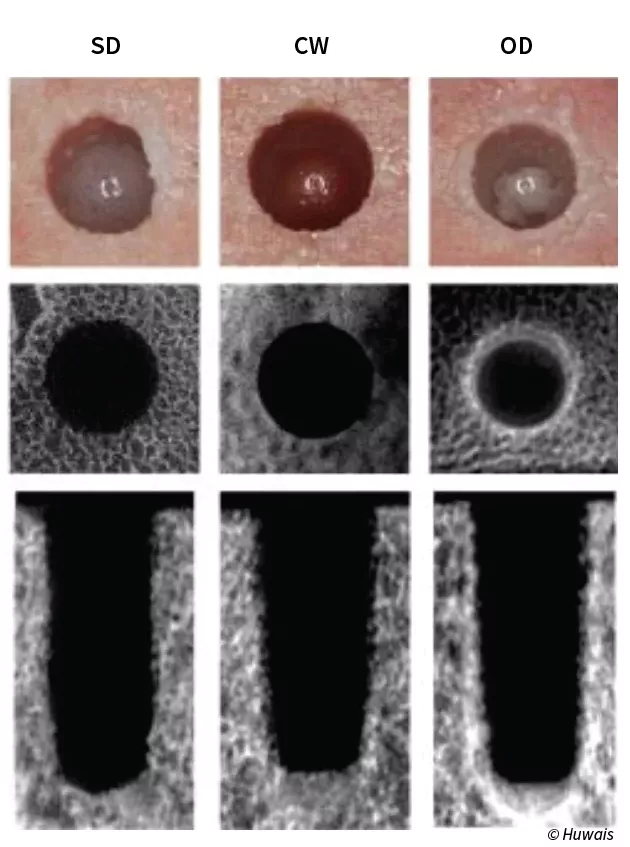
Traditional twist drills cut and remove bone as they advance; leaving behind a wider, weaker, less cylindrical osteotomy. Densah Burs from Versah work in reverse. Rotating counterclockwise at high speed (1000 rpm), the patented flute geometry glides along the osteotomy walls. It compacts trabecular bone outward and toward the apex instead of extracting it.
The result is a denser, stronger site that grips the implant securely from the moment it is placed, something referred to as the “spring back effect.” That precise geometry is the whole reason the technique works. A bur that only looks similar will not behave the same way once it is turning inside real bone.
Osseodensification is a validated shift in how bone responds to preparation. It gives clinicians more control over outcomes in bone types that used to complicate treatment planning. For patients, that often means a smoother recovery and fewer surprises at follow-up.
One System, Every Implant Geometry
A common misconception is that densification only works with certain implant brands or bone types. In reality, Densah Burs are engineered to work across implant systems, geometries, and both arches. A clinician can place implants in the anterior maxilla or the posterior mandible with the same bur system.
 a
a
Practices do not need a separate kit for every implant line they use. For clinicians managing multiple implant lines, an Implant System Drilling Reference Guide makes it easy to match bur sequences to specific systems. When properly maintained, genuine Densah Bur kits support a mixed-system practice, which simplifies inventory and training. Densah Burs have been tested for ideal utilization, typically 20 to 23 uses.
Protocols Built for Real Clinical Situations
Densification by Versah is not limited to standard implant placement. Versah has published protocols for crestal sinus lift, ridge expansion, molar septum expansion, immediate implant placement, and more advanced techniques like guided expansion grafting. Each protocol follows the same underlying principle: preserve bone, do not remove it.
Clinicians who once referred out lateral window sinus lifts or ridge grafting are now treating many of these cases themselves. The full library of clinical protocols offers step-by-step guidance for each technique. That guidance shortens the learning curve considerably.
More Predictable Outcomes
When a technique performs consistently, patients notice. Shorter procedure times and fewer complications add up quickly. So does the ability to treat compromised bone in-house instead of referring it out. Many clinicians using densification keep more treatment under their own roof.
Peer-reviewed research increasingly supports what many clinicians have already noticed in practice. A systematic review comparing osseodensification with conventional drilling found higher bone density around the implant site in most of the included studies. Other research has reported measurable increases in insertion torque and implant stability quotient values with osseodensification.
This body of evidence was built entirely on validated Densah Burs, not on the counterfeit versions now showing up online at steep discounts. Versah maintains a growing archive of published papers spanning biomechanical, histological, and clinical research. Clinicians can review that evidence directly before adopting the technique in their own practice.
Osseodensification also saves time in ways that add up over a busy schedule. Fewer referred-out cases mean fewer coordination calls and fewer handoffs between offices. Shorter chair time per case means more patients seen without sacrificing care quality. A counterfeit bur can undo all of that. If it behaves unpredictably at the osteotomy site, overheats, or fails to densify bone properly, the time saved elsewhere disappears the moment a complication shows up. For a growing practice, protecting predictability is worth more than whatever a lower, unvalidated bur might save on price.
Making Osseodensification Part of Standard Care
Osseodensification has quickly become a standard of care for clinicians who want predictable outcomes and fewer complications. It is also a technique that works across nearly every case a clinician sees. Practices that adopt it consistently, not just for hard cases, tend to see the biggest gains. Those gains show up in patient outcomes, referrals, and chairside efficiency.
If you are ready to bring osseodensification into your protocol, send a message to the Versah team. We would love to talk through the science, the protocols, and the right setup for how you work.